
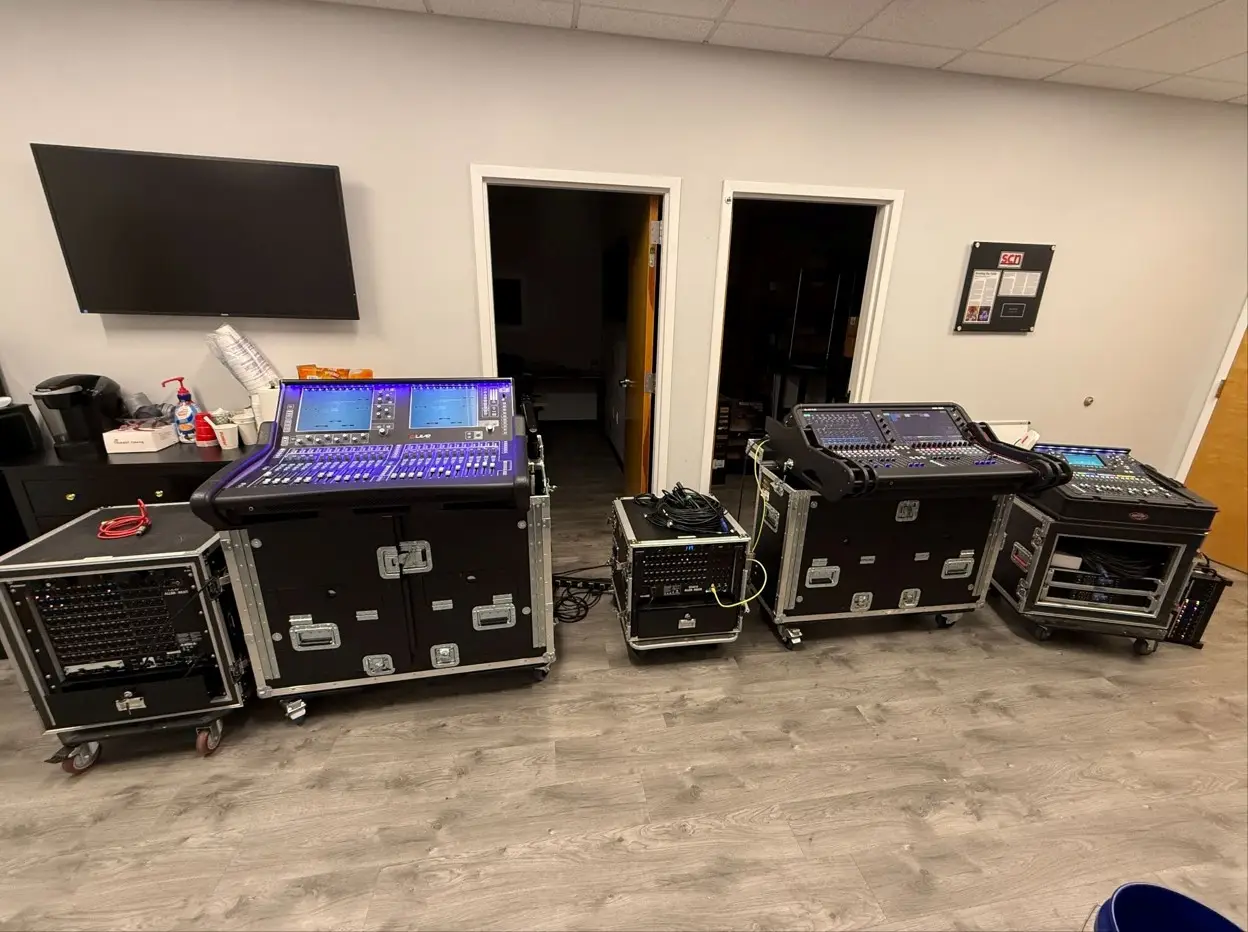
Monday was rainy, so we did something that's easy to keep putting off: we sat down and ran firmware updates on our entire console lineup. Our Allen & Heath dLive system, our Avantis, and our SQ-5 all got the treatment, along with the stage boxes that go with them.
If "firmware update" makes your eyes glaze over, you're not alone. It's one of those maintenance tasks that never feels urgent until it becomes a problem at the worst possible time. Here's what it actually is, why it matters, and how we handle it for our own gear and our clients' gear.
What a Firmware Update Actually Is
Firmware is the software built into a piece of hardware that tells it how to run. On a mixing console, firmware controls everything from how the processing engine handles audio to how the surface talks to the stage boxes on the network. When a manufacturer releases a firmware update, they're pushing out bug fixes, security patches, and often new features the console didn't originally ship with.
Think of it the same way you'd think about updating your phone. Skip enough updates and eventually something stops working right, or you're missing a feature everyone else already has.
Why Firmware Updates Matter
Firmware issues don't always announce themselves. A console can run for months without an update and seem fine, until a specific feature doesn't work the way it should, a security vulnerability goes unpatched, or you're missing functionality you're already paying for because the console never got the update that unlocked it.
Compatibility is often where it shows up first. A system that's run the same way for years can suddenly have trouble talking to a new wireless mic system, a streaming encoder, or a Dante-networked device if its firmware hasn't kept up. And because most modern consoles are networked, whether for remote control, Dante audio, or integration with other gear, outdated firmware is also a real security exposure, not just an inconvenience. It's one of the reasons regular AV system service matters even when nothing seems broken.
We run firmware checks on our own consoles regularly, and we do the same for client systems.

What We Updated This Week
Our dLive CDM64 and C3500 system is running the latest firmware across the control surface and the processor. We're an Allen & Heath certified dLive shop, so we stay current on how these updates affect the whole signal chain, not just the console itself. Our Avantis and GX4816 got updated too, along with our SQ-5 paired with a DX168 stage box.
Every one of those updates brought a mix of stability fixes and new features. The details vary release to release, which is exactly why we don't skip this step.
What We've Learned Doing This for Years
Update the stage boxes, not just the console. If your stage boxes aren't connected and powered on when you run an update, they won't update correctly, and you'll end up with a console and stage box that are out of sync. We always plug everything in before starting.
Back up your show file before you touch anything. A major firmware jump can wipe or alter saved scenes and settings. Backing up first takes a few minutes. Rebuilding a show you've spent years fine-tuning does not.
Read the release notes first. We check what's actually changing before we push an update. Sometimes a menu location or a workflow shifts, and it's better to know that ahead of time than to have whoever runs the board discover it live.
We don't always jump on the very first release. When a manufacturer puts out a 2.0 firmware, we'll often wait for the 2.1 release before pushing it to a client's system. Early releases sometimes carry their own bugs, and we'd rather let those get sorted out before we put it in front of a congregation or an event.
Test it before you trust it. An update isn't finished when the console reboots. We run a full check afterward to confirm everything still talks to everything else the way it should, rather than assuming it worked.
Waiting too long makes the eventual update riskier. The longer a system goes without a firmware check, the bigger the jump gets when you finally do it, and the more that can go wrong in one sitting. If a release is loaded with bug fixes, we treat it as a priority and update sooner. For a stable system, like most of our church clients' installs, checking once a year is usually plenty as long as it doesn't slide past that.

We Handle This for Clients Too
If you own AV gear and aren't sure when it was last updated, that's a conversation worth having before it becomes a problem, not after. This is also an easy step to lose track of, or for a well-meaning volunteer to run without backing anything up first. We do firmware updates as part of our regular maintenance service for clients, and we're happy to check your system before an issue shows up when the spotlight's on you.
Reach out to RYGID AV if you want us to take a look.
.webp)
Recommended articles
Explore our latest news & articles below


Where to Contact + Connect with RYGID AV
Mooresville, NC 28117
Mooresville, NC 28117