
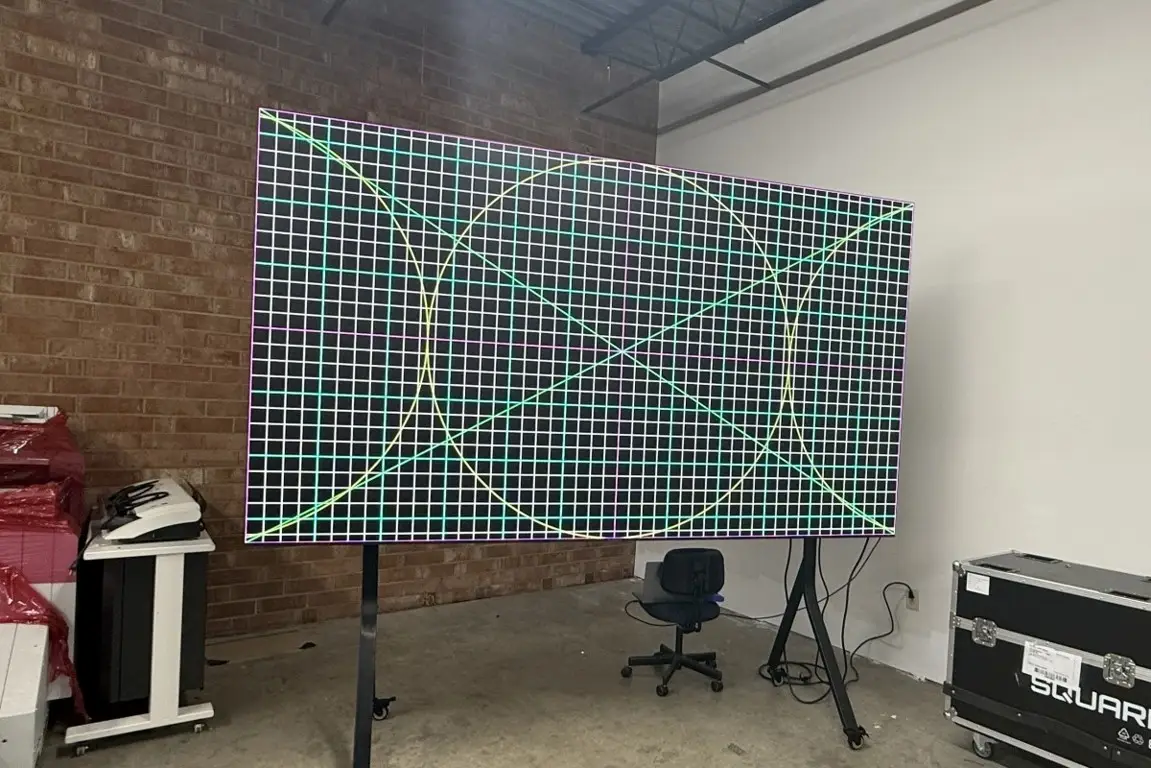
I was on-site for a demo day with a client in Greensboro a few weeks back, watching our team piece together a wall panel by panel, and it hit me again how much confusion there is around what people mean when they say "video wall." I hear the term used for at least three different things, and half the time the person saying it isn't sure which one they actually want.
So let's clear it up. If you want the basic definition first, we've got a quick primer on that; this piece picks up from there. If you're looking at a big display for a conference room or a sanctuary, you've probably run into the terms video wall, LED wall, and maybe "all-in-one." Here's what each of those actually means, and, more importantly, which one belongs in your space.
The Original "Video Wall"
"Video wall" has been around longer than most people think. The concept goes back to CRT monitors tiled into a grid in the '80s, then rear-projection cubes that took over through the '90s in control rooms and broadcast. You'll still catch one running in an older command center if you look. But the version most people picture when they hear "video wall" today came after that: a bunch of flat-panel TVs, LCD or sometimes LED-backlit LCD, butted together edge to edge and driven as one big image instead of several small ones.
It's still around, and it still has a place. It's a relatively affordable way to get a big picture, and for the right application, that's all you need.
But it comes with real tradeoffs. Every one of those panels has a bezel, a frame around the screen, so no matter how thin the manufacturers get them, you end up with a visible grid over your image. We call it the "crosshair" effect: stand back and look at the wall, and you'll see faint lines where every panel meets. There's also latency to deal with: a slight lag between how fast each individual display refreshes, which can show up as a stutter across the image. And getting a wall of TVs perfectly aligned, both physically and electronically, is harder than it looks. It takes real skill to get flush, gapless, and color-matched across a dozen panels, and even done well, you're still going to see the seams.
Direct-View LED: A Different Animal Entirely
What our team was building in Greensboro wasn't a video wall in that sense at all. It was a direct-view LED wall, or dvLED, with no TV chassis and no individual screens. It's built from LED modules that tile together edge to edge, and when it's calibrated correctly, the image reads as one seamless surface instead of a grid of separate displays. That calibration pattern in the photo above, the crosshair grid glowing across the panels, is literally the tool we use to get every module talking to every other module correctly before the wall goes live.
Two terms you'll hear if you go looking: GOB (glue-on-board) and COB (chip-on-board). Both are ways of packaging the individual LEDs directly onto the board and sealing them, rather than mounting each one as a separate surface-mounted component. The practical effect is a smaller, more durable pixel, which means you can pack them tighter without them being fragile. The tighter that pixel pitch gets, the closer you can stand to the wall before you start to see individual dots instead of a clean image.
That's the part people miss: pixel pitch isn't really about a "resolution" number on a spec sheet. It's about your viewing distance and what the room actually needs. A wall with a wider pixel pitch can look completely seamless from 20 feet away in a lobby or a sanctuary, while a tighter, pricier pitch might be solving a problem you don't have if nobody in the room ever gets closer than 15 feet. The first question I ask every client isn't "what resolution do you want." It's "how far back will people actually be sitting?" If you want to go deeper on pixel pitch and what actually separates a good dvLED wall from a mediocre one, we've got a full breakdown here.
dvLED also has a real advantage over projection in a lot of these spaces: higher contrast, a brighter image, and it doesn't care what the room lighting is doing. You're not fighting sunlight through the windows or stage lighting washing out the picture, the way you would with a projector.
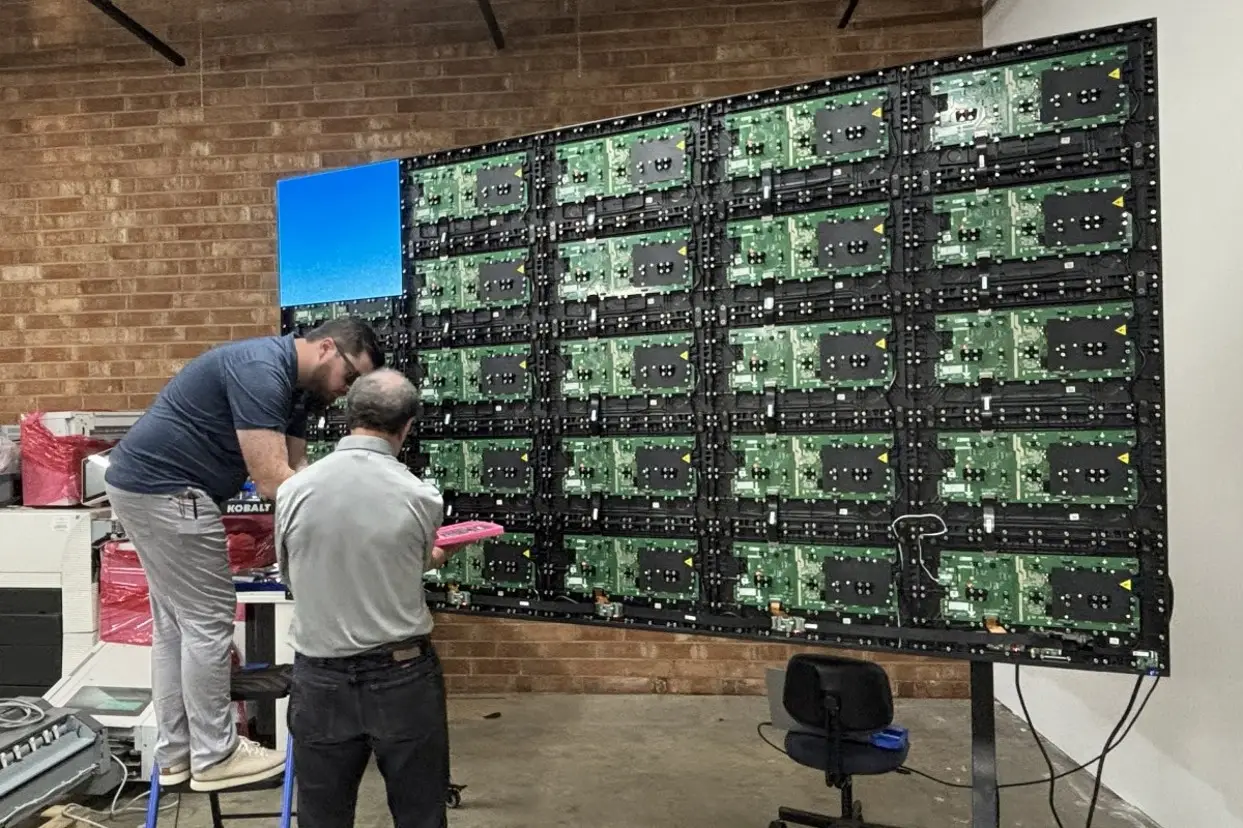
The All-in-One: Why LED Suddenly Got Affordable for Conference Rooms
This is where it matters most for conference rooms. A newer category of product, the all-in-one or AIO dvLED kit, has basically repackaged this technology as an oversized TV. Instead of a fully custom-engineered wall, you're getting a pre-built kit in a size class: 110", 135", 165", and up. True 1080 HD image, simpler install, and a price point that finally makes sense for a conference room budget.
For that application, it's a great fit. Conference rooms have moderate viewing distances and content that's mostly static or slow-moving: slides, video calls, a shared screen. At that distance, with that content, you can't tell the difference between this and a much more expensive custom build. It's the right tool sized to the right job.
Where I'd steer you away from it is anywhere the room's demands are different: a church sanctuary running full worship graphics and camera work, a space built around fast-moving video content, or anything closer to a "watch the game" environment. These AIO kits are built around a lesser chip and a lower LED count than a full custom dvLED wall, and that tradeoff shows up exactly in the situations a conference room doesn't ask for: motion-heavy content and close, sustained viewing. That traces back to driver quality and refresh rate, which we cover in more depth in our dvLED buyer's guide, especially relevant if you ever plan to put a camera on this wall for streaming. The technology isn't bad, it's just built for a specific job, and that job is the conference room, not the sanctuary.
Two Questions That Actually Matter
If you're trying to figure out which of these belongs in your space, skip the spec sheet and ask two things instead: how far back will people be sitting, and what are you actually going to put on the screen? A conference room and a worship space can both technically use "an LED wall," and still need two completely different products underneath that label.
That's the conversation I'd rather have with you before you buy anything, not after.
Trying to figure out what belongs in your conference room or sanctuary? Contact RYGID AV. We'll walk your space, talk through how you'll actually use it, and tell you straight which option fits. If you want to see the range of what's out there first, our visual AV solutions page is a good starting point.
RYGID AV | 122 Backstretch Ln., Mooresville, NC 28117 (980) 263-9194 | info@rygidav.com
.webp)
Recommended articles
Explore our latest news & articles below


Where to Contact + Connect with RYGID AV
Mooresville, NC 28117